
- Home
- Programmes
- LRN Foundation Year
LRN Foundation Year
Level 3 Diploma in Pre‑U Foundation Studies
Designed to help you build your understanding and knowledge of the pathway you want to pursue at university. You build the core skills every university expects, then study subjects built around your degree, all assessed through coursework.
Download the LRN Foundation Year prospectus (PDF, 3.2 MB) Islamabad, Karachi or onlineThe bridge between school and university
A pre-university programme that prepares you for undergraduate study at international universities.
It builds the subject knowledge, academic English and study skills universities expect from your first day, so you arrive ready to learn rather than ready to catch up.
Planning to study abroad
You want a degree in the UK, Australia, Canada or Europe and need a recognised bridging qualification.
Looking for another route
You may not meet direct entry requirements yet, or want to strengthen your profile first.
Wanting stronger preparation
More practice in academic writing, research and English before degree-level study.
Weighing up A Levels
A focused alternative to A Levels, or a way to build on your Intermediate studies.

Watch: the LRN Foundation Year in under two minutes
Who the LRN Foundation Year is for, what you study, how you are assessed and where it can take you.
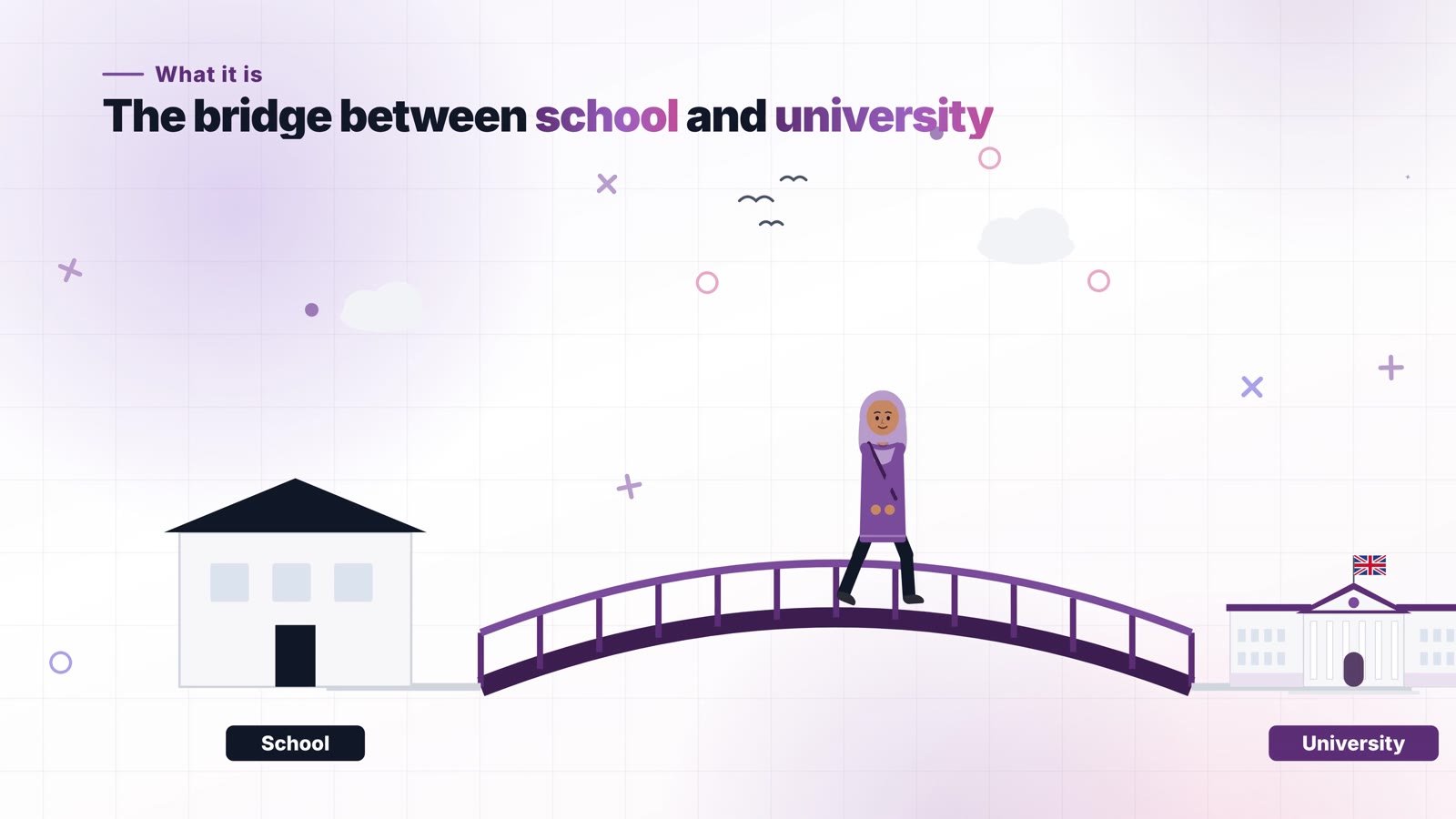 The LRN Foundation Year, explainedYour bridge between school and university
Universities that accept the LRN Foundation Year
The LRN Level 3 Diploma in Pre-U Foundation Studies has been accepted by universities across the UK, and leads to universities in Pakistan with IBCC equivalence. UK examples:









Check each course. Universities decide course by course which qualifications they accept and what grades they need, and this can change. An advisor will check your shortlist with you before you enrol.
Apply while you study. You apply to universities during your Foundation Year, so offers can arrive before you finish.
Four core modules
Every student takes four core modules. They build the skills that make the difference in your first year at university.
Foundation Study Skills
- Academic writing and referencing
- Research methods and critical thinking
- Presentation and communication
English for Academic Purposes
- Academic reading and writing
- Listening and speaking for lectures
- Vocabulary for higher education
Foundation Mathematics
- Numeracy and algebra
- Statistics and data interpretation
- Problem-solving for business and science
Foundation Computing
- Digital literacy and office applications
- Basic programming concepts
- Information systems and data
Five pathways, each built around a degree
Alongside the core modules you study subjects linked to the degree you want.
Life and health sciences
- Degrees
- Biotechnology, biochemistry, pharmacology, environmental science
- Careers
- Biotechnologist, biochemist, microbiologist, pharmacologist
Engineering and physical sciences
- Degrees
- Engineering, physics, materials science, space science
- Careers
- Engineer, aerospace engineer, materials scientist, physicist
Computing and technology
- Degrees
- Software engineering, data science, cyber security, AI
- Careers
- Data scientist, cyber security specialist, cloud engineer, app developer
Business and finance
- Degrees
- Accounting, finance, management, entrepreneurship
- Careers
- Chartered accountant, investment banker, entrepreneur, business analyst
Humanities and social sciences
- Degrees
- Psychology, law, education, policy, social research
- Careers
- Psychologist, lawyer, educator, policy analyst
Planning to study medicine? Medical schools set strict subject and qualification requirements, and this route is not usually the standard path into medicine or dentistry. A Levels are usually the safer start. Speak to an advisor before you choose.
Steady progress, not one big exam
If you do better through continuous work than in an exam hall, this route is built for you.
Coursework-based
Assessed across the programme, not in a single exam season.
One written exam
A single written Mathematics exam at the end.
Varied assignments
Essays, reports, presentations, projects, quizzes and tests.
Continuous feedback
Regular feedback, so you always know where you stand.
A recognised UK qualification
- Level 3 Diploma, 180 credits. Awarded by Learning Resource Network (LRN), UK.
- UCAS tariff points that count towards UK university applications.
- IBCC equivalence on application, so you can apply to universities in Pakistan. Requirements apply.
Matric or O Levels
Or an equivalent qualification
Level 3 Diploma
180 credits and UCAS points
University
In Pakistan, the UK and beyond
Awarded by LRN, an award-winning UK exam board
Learning Resource Network is recognised by Ofqual, the qualifications regulator in England, and has supported more than 1.2 million candidates in 58 countries.
One of the UK’s highest business honours, given to 185 organisations in 2026.
LRN’s first Royal honour; the King’s Award is its second in six years.
UK Department for Business and Trade. The first exam board to be recognised in the Education and EdTech category.
Award and membership details from Learning Resource Network (lrnglobal.org), 2025–2026.
What you need to apply
Three start dates a year, so you can begin when you’re ready.
Academic qualifications
Matric, O Levels or an equivalent international secondary qualification.
English
CEFR B1, about IELTS 4.0 to 5.0. Some universities accept the course’s English modules in place of IELTS.
Mature students
Applicants with work experience or other qualifications are considered individually.
How to apply
Book free counselling
Visit, call or WhatsApp us.
Choose your pathway
We review your results and goals.
Send your documents
Latest results and any English scores.
Enrol and start
September, January or May.
Every Foundation Year says “UK recognised”. Which one holds up?
Four Foundation Years you will hear about in Pakistan, checked on the seven things that decide where you can go next.
| The check | LRNat ICE | NCC Education | Pearson BTEC | City & Guilds |
|---|---|---|---|---|
| UCAS Tariff points | Up to 144 | No fixed tariff | None | Not stated |
| IBCC equivalence in Pakistan | Humanities and Science | Humanities | Not found | Humanities only |
| Ofqual regulated | Regulated | Regulated | Not UK regulated | Not stated |
| Ecctis benchmark | Not published | Not published | Not published | Not published |
| Replaces IELTS? | Some universities | IELTS scores listed | Not stated | Not stated |
| What you study | 6 units | 6–7 units | 8 units | 3 core + combinations |
| Where it can take you | Pakistan and abroad | 100+ in 20+ countries | Pearson HNDs | 150+ (claimed) |
- Distinction
- 144
- Merit
- 96
- Pass
- 48
Up to 144 UCAS points
From each awarding body’s published information, checked October 2026. “Not stated” or “Not published” means we could not find it published, not that it is untrue. Always confirm with the universities on your shortlist.
In their own words
Class of 2026 graduates, and alumni stories from the ICE News Bulletin, Fall 2025.
ICE played an important role in helping me reach this milestone. Having that support made the transition from studying in Pakistan to starting university in Manchester feel more manageable.
 Sheikh Abdur Raheem OmerInternational Foundation Year, Class of 2026
I knew I wanted to study engineering in the UK, and the Counselling team helped me turn that goal into a plan. Getting into Sheffield is a milestone I’ll always be thankful to ICE for.
Studying law during my foundation year gave me an early introduction to the subject and helped me feel more confident as I moved into university.
 Muhammad Asad ChaudharyInternational Foundation Year · Overall Merit, Class of 2026
At ICE, I learned that there is no one path, no one timeline, and no one definition of success. There is no “right” way to succeed, there’s simply your way.
 Khadija NoorInternational Foundation Year · Overall Distinction, Class of 2026
My experience taught me the importance of staying focused, managing time effectively, and never giving up on my goals.
 Malik MehroshInternational Foundation Year · Distinction, Class of 2026
The ICE Counselling team helped me shortlist the right universities and kept pushing for scholarships. Receiving my offer with a 40% scholarship wouldn’t have happened without them.
Success doesn’t come easy, but ICE made sure I was never on my own.
Plan smart, stay consistent, and take it one step at a time.
 Fatima KaleemICE graduate · University of Greater Manchester
ICE gave me the foundation to move forward with confidence.
ICE supported me at every stage, from academic preparation to securing university admission.
 Muhammad FasihICE graduate · University of Huddersfield
Watch their stories



Fees and scholarships
Fees depend on your pathway and campus. An advisor will give you the current fee schedule and explain any scholarships you could qualify for.
Add AI skills to your Foundation Year
The LRN Foundation Year is assessed mostly through coursework, so research and writing matter. Learn to use AI for research, planning and feedback honestly, and to cite it properly.
- ReadResearch and understand faster
- WritePlan, draft and improve your writing
- SpeakPresent and speak with confidence
Free for students enrolled at ICE Pathways9am to 5pmIslamabad and Karachi campuses
Tools students learn to use well
 ChatGPT
 Claude
 Gemini
 Copilot
 Perplexity
 NotebookLM
 Grammarly
 ElevenLabs
Tool names and logos are trademarks of their owners. ICE Pathways is not affiliated with or endorsed by them. Tools change quickly, so we teach the skills behind them.
LRN Foundation Year questions
Message us on WhatsApp
How long is the Foundation Year?
16 to 18 months, full time, on campus in Islamabad or Karachi, or online. You can start in September, January or May.
Who awards the qualification?
Learning Resource Network (LRN), a UK awarding organisation recognised by Ofqual. You earn the Level 3 Diploma in Pre-U Foundation Studies, with 180 credits.
Which universities accept it?
Examples include Royal Holloway and SOAS (University of London), Heriot-Watt, Sussex, Middlesex, Greenwich, Essex, Chester, Sunderland, Bangor and the University of Wales Trinity Saint David. It also leads to universities in Pakistan, with IBCC equivalence. Acceptance is decided course by course, so we check your shortlist with you.
How am I assessed?
Mainly through coursework: essays, reports, presentations and projects, with regular feedback. There is one final written Mathematics exam.
Do I need IELTS?
To enrol you need English at about CEFR B1 (IELTS 4.0 to 5.0). For university, some accept the course’s English modules in place of IELTS; others ask for an external test.
Can I study at a university in Pakistan afterwards?
Yes. Once the IBCC issues equivalence, you can apply to universities in Pakistan. Requirements apply.

Download the LRN Foundation Year prospectus
Everything in one place: what you study, entry requirements, where it leads, and how to apply. Share it with your family.

Book your free counselling session
Talk to an advisor about your results, the degree you want and whether the LRN Foundation Year is right for you. Available in Islamabad, Karachi and online.